Weather_Trentino
Trentino Weather
A KGE Project’s Website
by Giacomo Lazzerini and Jacopo Clocchiatti
Academic year 2022/2023, University of Trento
link: Official Course Website
link: Project Repository
link: Project Report
link: Project Slides
Introduction
Weather influences many aspects of our lives. In the past, knowing the meteorological status and its possible changes over time was vital for agriculture, transportation, and even the culture of many communities. Today, weather is still very important, and it can significantly impact everyday life. Modern technologies, measurement techniques, and climatology studies allowed reaching such high levels of accuracy to predict the future often correctly. From knowing if to bring the umbrella with you before going outside, knowing if the next weekend will be a good day for a picnic, or being able to monitor atmospheric conditions remotely, the weather has always played a crucial role in human beings’ life.
Our resource can be seen not only as an alternative to already existing and largely used weather services but also as a resource specifically created for Trentino Region, a service that can give information about the future (forecasts) but also about the present (meteorological station measurements) and past (historical data). In this resource, we integrated the chance to explore historical data and to know astronomical features available on a daily basis. We believe that enriching the experience with new ETypes can open new usage opportunities to a category of personas not considered so far.
In this project, we used weather data from Trento province to build a Knowledge Graph (KG). This has been possible using the iTelos methodology. iTelos is a phase-based methodology that allows the implementation of a KGE process.
Domain of Interest
For the scope of this project, we considered data:
- from a day before to the moment of the query for weather measurements.
- from the moment of the query to five days in the future for weather forecasts.
- from 1973 to 2022 for historical data.
We can describe the purpose as a user request as:
“A service which helps users to know about the various weather observation sites and weather forecasts in different parts of Trentino.”
Our resource’ structure is born with a snapshot of historical weather archive data that has been collected up to 1973, then it will serve as a framework to build new historical records of weather measurements collected over time. Data streams will populate the database and they will be used as historical data for future use cases.
Datasets
Most of the datasets come from the same site, Open Data Trentino, which is a data catalogue that allows to search, access, download, and preview open data collected in the Trentino province through a single access point. There are other closed datasets available, but only after payment. We added information about Astronomical Metrics (e.g. sunset and sunrise time depending on coordinates and day) provided by a Python library, Skyfield. Lastly, we scraped historical data for our location from ilMeteo.it.
Meteotrentino, which is the administrative structure of Trentino province that deals with meteorology, snow science, and glaciology. We used several datasets that are present in the catalogue mentioned before. We can divide those datasets in agraphic datasets and active datasets (the ones with weather information). Almost all the datasets come in XML format and a couple comes in JSON format. All the datasets’ structures are the same since 2013, the year when they were released. The datasets we used are:
-
Last data of meteo stations: this operation gets data from the specified weather station. The operation requires a code station as a parameter and returns temperature (°C), precipitation (mm), wind velocity (m/s), wind direction (gN), global radiation (W/mq), relative humidity (%), snow depth (cm). Data refers to the time period starting from the day before the query at 0:00 to the time of the last data collected today. Data comes in an XML format.
-
Bollettino meteo probabilistico giornaliero: daily weather forecast for Trento province computed with probabilistics methods (snowfalls, precipitations, thunderstorms, winds, freezing level). Data comes in a JSON format.
-
List of meteorological stations: each point of measure exposes these attributes: code, name, short-name, elevation, latitude, longitude, startdate, enddate. If enddate attribute is null its mean that the station is active, else this station does not exist (has only past data). Data comes in a XML format.
-
Dati recenti delle stazioni meteorologiche automatiche: the dataset contains, through an endpoint, recent data from weather stations belonging to the automatic measure- ment network. Those data refers to the time period from midnight of the day before and data are about temperature (°C), precipitation (mm), wind speed (m/s) and direc- tion (gN), global radiation (W/mq) of the specified weather station. Data comes in a XML format.
-
Bollettino meteorologico di località JSON: Weather forecast for each locality can be accessed by this endpoint. Data comes in a JSON format.
-
Indice di Calore (Humidex): many indexes are used to estimate the discomfort related due to warm and humid climate. Meteotrentino uses HUMIDEX index, developed in Canada in 1965. Data comes in a XML format.
Servizio Prevenzione Rischi is the author of all these datasets and is responsible for their update.
-
Skyfield computes positions for the stars, planets, and satellites in orbit around the Earth. Its results should agree with the positions generated by the United States Naval Observa- tory and their Astronomical Almanac to within 0.0005 arcseconds.
-
ilMeteo.it, an italian web company specialized in the provision of services and communi- cation of weather forecasts. The data are aggregated by the site from different sources and provided in a XLSX format, available in daily, weekly and monthly format for different time periods
ER Diagram and ETG
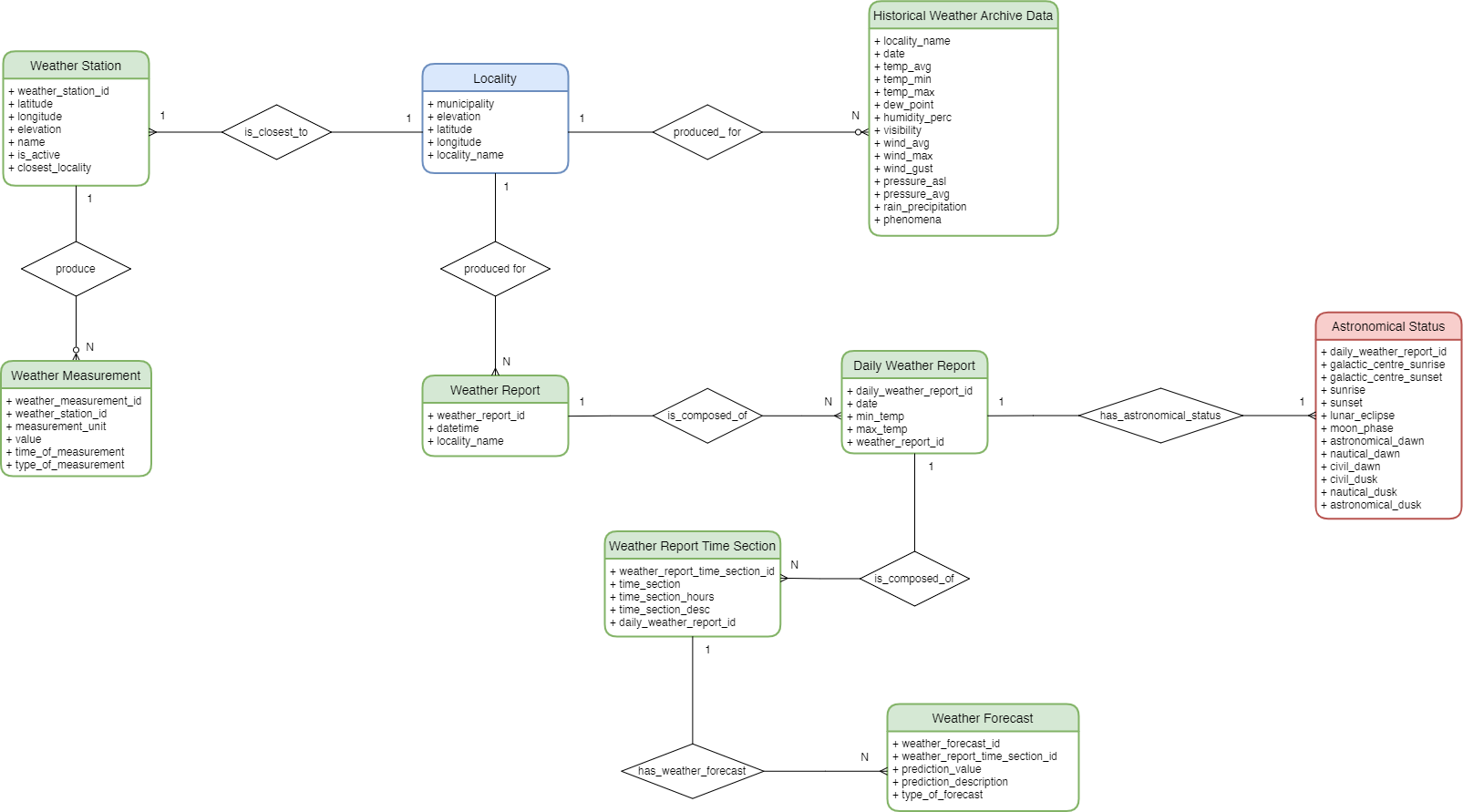
The following diagram shows the structure of our resource. (More details available at the official repository of the project)
9 classes and 49 properties (written between the parentheses):
- Locality (name, municipality, latitude, longitude, elevation)
- Weather Station (name, latitude, longitude, elevation, is_active)
- Weather Measurement (date, type, value, measurement unit)
- Weather Report (date)
-
Daily Weather Report (date, max_temperature, min_temperature)
- Astronomical Status (sunrise, sunset, moon_phase, astronomical_dusk, astronomi- cal_dawn, nautical_dusk, nautical_dawn, civil_dusk, civil_dawn, galactic_centre_sunrise, galactic_centre_sunset)
- Weather Report Time Section (time_section_slot, time_section_hour, time_section_description)
- Weather Forecast (type, value, description)
- Historical Weather Archive Data (date, avg_temperature, min_temperature, max_temperature, dew_point_temperature, rain_precipitation, avg_preassure, preas- sure_asl, avg_wind_speed, max_wind_speed, wind_gust_speed, perceived_humidity, visibility, phenomena)
 |
|---|
| ER Diagram |
| Annotated ETG | Data Properties |
|---|---|
 |
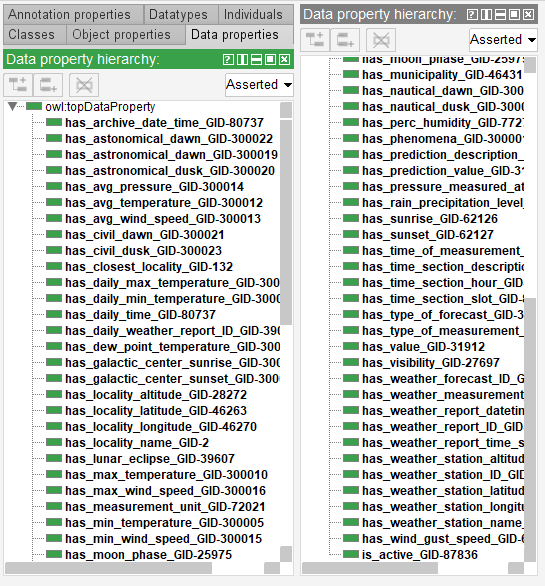 |
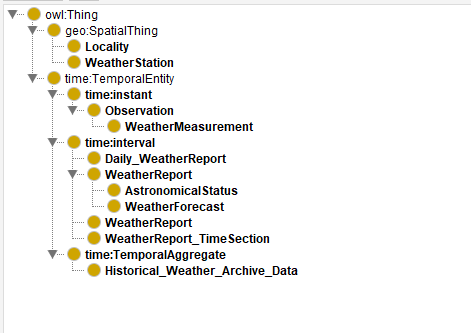
Final ETG